St. Phillip's Church
St. Philip's Church is one of the most iconic landmarks in Charleston, South Carolina, making it a must-see on any Charleston architecture tour. Rising dramatically above Church Street with its white steeple and copper clock, St. Philip’s has observed Charleston endure fires, hurricanes, wars, earthquakes, epidemics, pirates, duels, and political upheaval for over three centuries.
Founded in 1680, St. Philip’s congregation is the oldest religious congregation in South Carolina and the oldest Anglican congregation south of Virginia. The original church building was a simple wooden structure located near the corner of Broad and Meeting Streets, on the current site of St. Michael’s Church. At that time, Charleston was a rough colonial settlement bustling with traders, planters, pirates, soldiers, enslaved Africans, and immigrants from England, Barbados, and France.
St. Philip’s has withstood numerous disasters that have ravaged much of the city. The congregation’s first building sustained hurricane damage in 1710, while the second church narrowly escaped devastation during the massive Charleston fire of 1796, thanks to the efforts of an enslaved Black boatman who climbed onto the burning roof and removed flaming shingles. As a reward for saving the church, he was granted his freedom. Sadly, another significant fire in 1835 completely obliterated the church building. The current structure was erected between 1835 and 1838, with the renowned steeple added from 1848 to 1850.
Notably, the church’s tower extends partially into Church Street, creating one of Charleston’s most famous postcard views.


The French Huguenot Church
Tucked quietly into Charleston’s famous French Quarter, the French Huguenot Church stands out as one of the city’s most unusual and beautiful churches. With its pale pink Gothic façade, dramatic iron details, pointed arches, and European appearance, many visitors mistake this gem for a transplanted church from rural France.
Today, the French Huguenot Church remains one of the rarest churches in America: the only independent French Calvinist congregation still active in the United States. The Huguenots, who were French Protestants heavily influenced by John Calvin during the Protestant Reformation of the 1500s, faced severe persecution in overwhelmingly Catholic France.
In April of 1680, the ship Richmond arrived in Charles Town carrying approximately 45 French Protestant refugees. By 1723, historians estimate that nearly 21 percent of Charleston’s European population had French Huguenot roots.
The original church was built in 1687 at the corner of Church and Queen Streets, precisely where the current church stands today. Unlike Charleston’s Anglican churches such as St Philip's Church, the Huguenot congregation followed French Calvinist traditions, conducting services entirely in French for generations. In fact, services were not regularly held in English until 1828.
The Dock Street Theatre
The original Dock Street Theatre,opened its doors in 1736 at the corner of Church Street and Dock Street (now Queen Street), making it the first building in the American colonies designed specifically for theatrical use. Its premiere performance was George Farquhar’s The Recruiting Officer, a popular Restoration comedy of the era. However, the lifespan of this first structure was short; it was likely destroyed during the Great Fire of 1740, which razed much of Charleston’s historic district, leaving the site vacant for nearly a century.
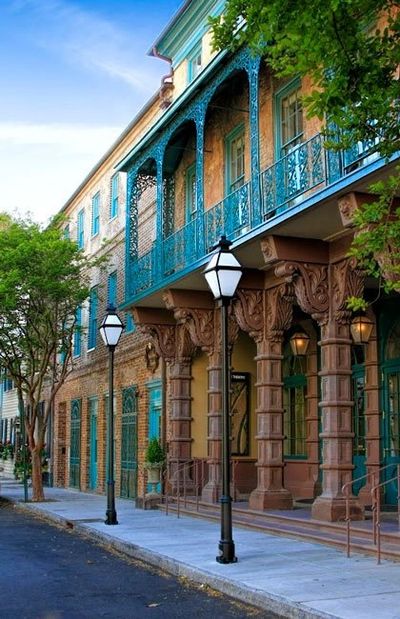
In 1809, the Planter’s Hotel was constructed on the ruins of the original theatre, showcasing the elegant wrought-iron balconies and sandstone columns that define the building’s exterior today. Throughout the 19th century, the hotel became a social hub for wealthy planters and travelers, and it is famously credited as the birthplace of Planter’s Punch. Following the Civil War, the building fell into a long period of neglect and structural decay, eventually becoming a candidate for demolition as the city struggled with economic hardship.
The building’s modern legacy began during the Great Depression when it was transformed through a massive Work Projects Administration (WPA) effort. Architects utilized locally salvaged materials, including cypress paneling and 18th-century woodwork from the old Radcliffe Mansion, to recreate a grand interior that captured the spirit of the 1736 playhouse. Reopening in 1937, the Dock Street Theatre returned to its roots as a performing arts venue. Today, it remains a centerpiece of the Charleston French Quarter, serving as the permanent home for Charleston Stage and a premier venue for the annual Spoleto Festival USA.
Chalmers Street

Chalmers Street
Slave Mart Museum
Chalmers Street
Chalmers Street is one of Charleston’s most iconic thoroughfares, renowned for being one of the few remaining streets in the city paved entirely with historic cobblestones. Originally known as Beresford’s Alley, this street features Bermuda limestone "cobbles" that were brought over by sailing ships during the 18th century. These stones s
Chalmers Street is one of Charleston’s most iconic thoroughfares, renowned for being one of the few remaining streets in the city paved entirely with historic cobblestones. Originally known as Beresford’s Alley, this street features Bermuda limestone "cobbles" that were brought over by sailing ships during the 18th century. These stones served as ballast to stabilize vessels on their transatlantic journeys; once the ships reached Charleston’s harbor to load up with rice and indigo, the stones were discarded on the docks and later repurposed to pave the city’s marshy, low-lying streets.
The Pink House
Slave Mart Museum
Chalmers Street
The Pink House, located at 17 Chalmers Street, is one of the oldest residential structures in Charleston, dating back to the late 17th or early 18th century. Constructed of pinkish-hued Bermuda stone—a soft coral limestone brought to the city as ballast on trading ships—the building is a rare example of a "gambrel-roofed" structure in the
The Pink House, located at 17 Chalmers Street, is one of the oldest residential structures in Charleston, dating back to the late 17th or early 18th century. Constructed of pinkish-hued Bermuda stone—a soft coral limestone brought to the city as ballast on trading ships—the building is a rare example of a "gambrel-roofed" structure in the French Quarter. Its petite footprint, originally consisting of only one room per floor across three stories, reflects the early colonial architectural style of utilizing narrow lots for combined residential and commercial purposes. Situated near attractions such as the Dock Street Theatre and the French Huguenot Church, the house has served various roles over its long history, from a private tavern for sailors and merchants to a law office and an art gallery.
Slave Mart Museum
Slave Mart Museum
Slave Mart Museum
The Old Slave Mart Museum on Chalmers Street was built in response to a 1856 city ordinance that banned the public auctioning of enslaved people. Before this ordinance, auctions were held outdoors, often on the north side of the Custom House or near the Exchange Building. As Charleston sought to project an image of 'refinement' and urban
The Old Slave Mart Museum on Chalmers Street was built in response to a 1856 city ordinance that banned the public auctioning of enslaved people. Before this ordinance, auctions were held outdoors, often on the north side of the Custom House or near the Exchange Building. As Charleston sought to project an image of 'refinement' and urban order, city officials deemed these public sales a 'nuisance' and moved the domestic trade behind closed doors. By the time the Mart was constructed, the international slave trade had been banned for over 50 years (since 1808), leading to a shift toward the domestic slave trade where individuals were 'sold south' from states like Virginia and Maryland to the expanding cotton and rice plantations of the Deep South.
Fire Insurance Companies
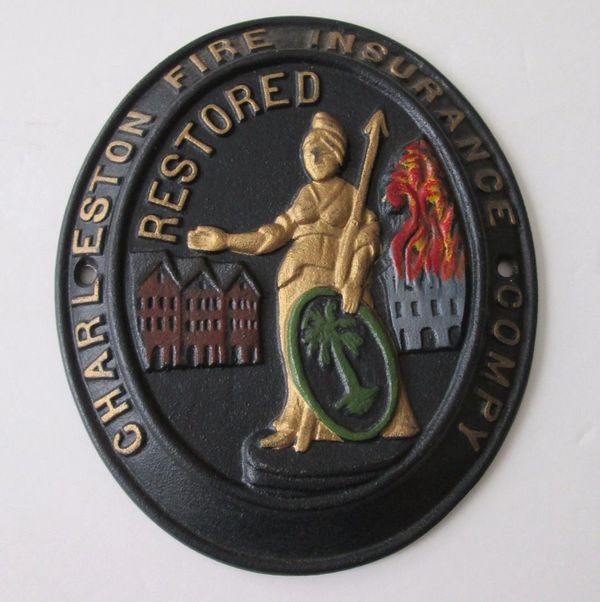
Charleston holds the distinction of being the birthplace of the first fire insurance company in the American colonies. In 1736, a group of local citizens formed the Friendly Society for the Mutual Insuring of Houses against Fire. Because colonial Charleston was built primarily of flammable materials like cypress and pine, and situated on a peninsula where sea breezes could whip a small spark into a city-wide inferno, fire was the greatest threat to the city's export-driven wealth. However, the Friendly Society was short-lived; it was bankrupt by 1740 after a massive fire destroyed over 300 buildings.
The People's Building
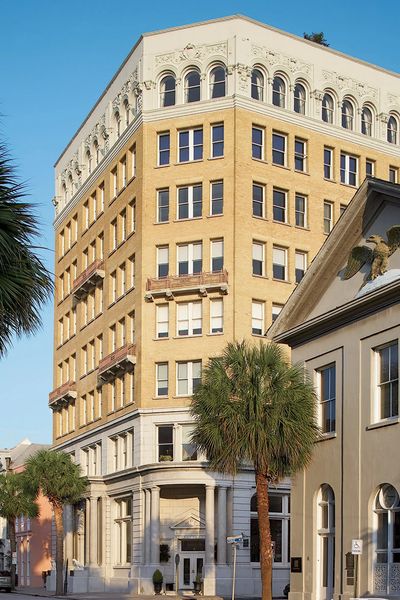
The People’s Building, completed in 1911, is often hailed as Charleston’s first "skyscraper." This impressive 8-story structure was commissioned by the People’s National Bank and sparked controversy among locals who believed it disrupted the historic skyline, which had long been characterized by the iconic church steeples such as St Philip's Church and the French Huguenot Church. The public outcry was so intense that it ultimately led to the enactment of local height ordinances.
Upon its opening, the building garnered immense attention, showcasing luxurious Italian marble, exquisite mahogany, and the city’s first high-speed electric elevators. Notably, the 11th President of the United States, William Howard Taft, visited the building’s roof during its inaugural year. From the observation deck, he famously exclaimed, "I don’t know that I’ve ever seen a view more beautiful," as he gazed over the harbor and the Ashley and Cooper Rivers.
However, the building’s namesake, the People’s State Bank, fell victim to the Great Depression. The bank's collapse in the 1930s sent shockwaves through the local economy and temporarily transformed the building from a symbol of progress into one of economic decline. It ultimately fell into neglect before being revitalized in the late 20th century.
The Colonial Waterfront

The Old Exchange Building
Completed in 1771 by the British colonial government, the Old Exchange and Provost Dungeon quickly became the economic and political heart of Charles Town. Built primarily as a commercial exchange and custom house, its upper Great Hall served as a grand space for public gatherings and the city's most critical colonial business. Beyond commerce, the building played a pivotal role in the American Revolution; it was here that South Carolina elected its delegates to the First Continental Congress and where the Declaration of Independence was first read to the public in 1776.
The building's darker history is centered in its basement, which became the infamous Provost Dungeon during the British occupation of Charleston from 1780 to 1782. The damp, dark space was used as a military prison to hold American patriots, British deserters, and high-profile prisoners. Outside its doors, the building also served as a major site for public slave auctions for over 80 years, a legacy now recognized by a historic marker on its north side.
In the post-Revolutionary era, the Old Exchange hosted legendary figures, including George Washington, who was honored with a grand ball there in 1791. Over the next century, it served various roles as a post office, city hall, and military headquarters, surviving fires, wars, and the Great Earthquake of 1886. The Daughters of the American Revolution saved the structure from demolition in 1913, and following an extensive restoration in the 1970s, it reopened as a museum in 1981, preserving its status as one of America's three most historic colonial public buildings.
Rainbow Row
Rainbow Row is perhaps the most iconic architectural landmark in Charleston, consisting of a series of thirteen colorful historic houses located on East Bay Street. These homes, dating back to the mid-18th century, were originally used as stores on the ground floor with living quarters above, situated conveniently near the bustling waterfront. After the Civil War, the area fell into disrepair and was considered a slum until the 1920s and 30s when Dorothy Porcher Legge purchased a section of the houses and began a restoration project, painting them a pastel "Caribbean" pink. This sparked a trend among neighboring owners, leading to the vibrant palette of blues, yellows, and greens that defines the street today.
Beyond its aesthetic appeal, Rainbow Row serves as a primary example of early American urban preservation. The houses are built in the Georgian style, characterized by their narrow fronts and deep floor plans, which were designed to maximize street frontage near the harbor. The preservation of these structures was a cornerstone of the burgeoning historic preservation movement in Charleston, helping to establish the city's reputation as a destination that values its colonial and post-revolutionary heritage.
Today, the row is a centerpiece of the South of Broad neighborhood, representing the successful integration of historic integrity with modern residential life.
For visitors and photographers, the row offers more than just a colorful backdrop; it is steeped in local lore and functional history. Common legends suggest the bright colors helped drunken sailors identify their guesthouses or served as a coding system for merchants, though historians generally credit the aesthetic to the 20th-century "Charleston Renaissance." Many of the homes still feature original details, such as heavy iron tie-rods used for earthquake reinforcement and decorative "insurance marks" that indicated to private fire companies that the building was protected. Walking along this stretch of East Bay Street provides a tangible connection to the maritime commerce and social evolution that shaped the Lowcountry.
Lower Church Street
The Dubose Heyward House
The Dubose Heyward House
The Dubose Heyward House
DuBose Heyward was an essential figure of the Charleston Renaissance, best known for writing the 1925 novel Porgy, which George Gershwin later adapted into the world-famous opera Porgy and Bess. Born in 1885 to an aristocratic family that had fallen into poverty, Heyward worked as a cotton checker on the Charleston waterfront, where he be
DuBose Heyward was an essential figure of the Charleston Renaissance, best known for writing the 1925 novel Porgy, which George Gershwin later adapted into the world-famous opera Porgy and Bess. Born in 1885 to an aristocratic family that had fallen into poverty, Heyward worked as a cotton checker on the Charleston waterfront, where he became fascinated by the Gullah culture that inspired much of his writing. His residence from 1919 to 1924, known as the Dubose Heyward house at 76 Church Street, is a modest two-story stuccoed structure where he penned the works that pioneered a more humanized and respectful depiction of Southern African Americans in literature. Visitors on a Charleston architecture tour can appreciate this historic site, which is near landmarks such as the Dock Street Theatre and the French Huguenot Church. Although the building was declared a National Historic Landmark in 1971, it has since been significantly altered and now serves as an attached wing to the larger three-story house at 78 Church Street.
Charleston Single House
The Dubose Heyward House
The Dubose Heyward House
The design of the Charleston single house is a hallmark of Charleston architecture, characterized by its narrow, rectangular form that is only one room wide, with its gabled end facing the street. This unique orientation allows the house to extend deep into its lot, featuring a central staircase hall that typically separates two main room
The design of the Charleston single house is a hallmark of Charleston architecture, characterized by its narrow, rectangular form that is only one room wide, with its gabled end facing the street. This unique orientation allows the house to extend deep into its lot, featuring a central staircase hall that typically separates two main rooms on each floor. A defining element is the piazza, a long, shaded porch running the length of the building’s side. The street-facing door is often a 'false door' or privacy screen that opens onto this piazza, while the actual entrance to the interior is located halfway down the porch, discreetly tucked away from public view. This single-room width facilitated effective cross-ventilation, allowing breezes to flow directly through windows on both sides of a room. Builders frequently oriented the piazzas toward the south or west to capture the prevailing summer winds from the harbor, providing deep shade that kept interior rooms significantly cooler before the advent of air conditioning. The roots of this design can be traced back to Barbados, a sister colony whose settlers founded Charleston in 1670. Features such as the side-facing veranda and slender profile were practical tropical building techniques employed in Bridgetown to withstand the intense sun.
First Baptist Church
The Dubose Heyward House
First Baptist Church
Founded in 1682 by settlers fleeing religious persecution in Maine, Charleston's First Baptist Church is the oldest Baptist congregation in the South. Its current sanctuary, completed in 1822, was designed by Charleston native Robert Mills, the first American-born professional architect and the designer of the Washington Monument. Mills d
Founded in 1682 by settlers fleeing religious persecution in Maine, Charleston's First Baptist Church is the oldest Baptist congregation in the South. Its current sanctuary, completed in 1822, was designed by Charleston native Robert Mills, the first American-born professional architect and the designer of the Washington Monument. Mills described this Greek Revival masterpiece as the city's finest example of 'correct taste,' featuring a grand Doric portico and an interior optimized for acoustics and visibility, setting a new standard for American church architecture. This building is a highlight on any Charleston architecture tour, serving as a testament to Mills’ obsession with permanence and functional design, traits also seen in his nearby Fireproof Building. Under the leadership of Pastor Richard Furman, the church became a pivotal site for the formation of the Southern Baptist denomination. Today, the sanctuary remains a National Historic Landmark, housing significant artifacts like a solid mahogany pulpit from 1822 and a rare 1845 Erben organ, preserving the legacy of both the congregation and its famous architect.
East Bay and The High Battery
The Promendade
The promenade at the Battery is a historic elevated walkway that stretches for roughly a mile along the southern tip of the Charleston peninsula, making it a perfect addition to any Charleston architecture tour. It is divided into two distinct sections: the 'High Battery' and the 'Low Battery'. The High Battery, which runs about 1,400 feet along East Battery Street, was built in the early 1800s and sits significantly higher than the street level, offering a grand view of the harbor and the row of famous antebellum mansions.
The Low Battery portion runs for another 5,000 feet along Murray Boulevard, extending the promenade along the Ashley River. This section was originally built in the early 20th century as part of a land reclamation project. Until recently, it was much lower and prone to frequent flooding, but a massive $71 million restoration project completed in early 2026 raised this seawall by nearly two feet. The now-unified promenade features a 12-foot wide walkway, new landscaping, and upgraded pedestrian access.
The Edmonston-Alston House
Built in 1825 by Scottish shipping merchant Charles Edmondston, the Edmondston-Alston House was one of the first substantial residences constructed along Charleston's High Battery, making it a significant stop on any Charleston architecture tour. Originally designed in the Federal style, the house was sold just over a decade later to Charles Alston, a wealthy rice planter, following Edmondston's financial losses during the Panic of 1837. Alston immediately modernized the estate with Greek Revival enhancements, adding the iconic three-story piazzas supported by Corinthian columns and a rooftop parapet featuring the Alston family coat of arms, which remains a unique architectural detail on the Charleston skyline.
The house is most famous for its "front-row seat" to the start of the Civil War; on April 12, 1861, Confederate General P.G.T. Beauregard stood on the second-story piazza to witness the fierce bombardment of Fort Sumter. Later that same year, the residence provided refuge to General Robert E. Lee after a massive fire uptown, threatening his safety at a local hotel. Today, the Edmondston-Alston House is one of the few house museums in the city to contain an extensive collection of original family furnishings, silver, and library books, offering an authentic glimpse into the 19th-century lives of both the Alston family and the enslaved people who labored on the property.
The Roper Mansion
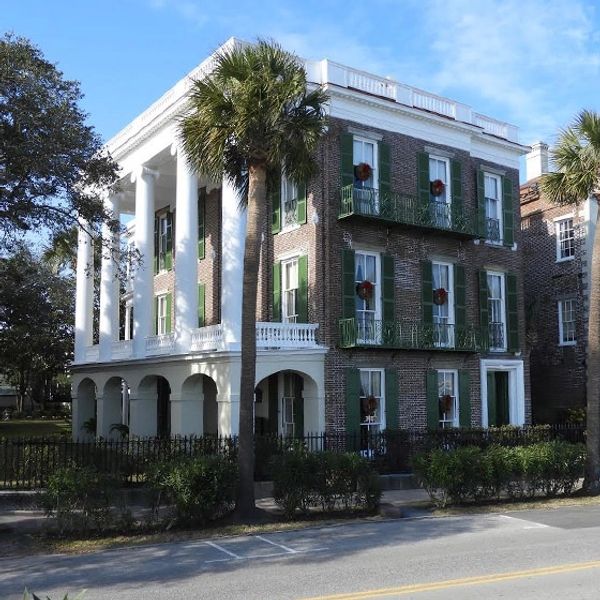
The Roper House, located at 9 East Battery, is one of Charleston’s most iconic examples of Greek Revival architecture. Built around 1838 by cotton planter Robert William Roper, the mansion is distinguished by its monumental scale and a side portico featuring five massive Ionic columns that rise above a high brick podium. The home was designed to be a bold statement of wealth and social standing, positioned prominently along the harbor to catch the cooling sea breezes. It has remarkably survived the Great Fire of 1861, the Civil War—during which a Confederate cannon burst in the nearby gardens and sent a fragment through the roof—and the devastating earthquake of 1886.
A unique architectural detail often associated with the house is the heavy "rope" molding carved into the stone or woodwork of the exterior. This feature is significant as a traditional nautical motif, symbolizing Charleston’s deep connection to maritime trade and the source of the city's early 19th-century prosperity. Beyond the decorative nautical link, some architectural historians suggest the rope serves as a pun on the original owner’s name, Roper. This subtle visual play was a common practice in grand historic homes, allowing the architecture to serve as a permanent, tactile signature of the family that commissioned the estate.

White Point Gardens
White Point Garden sits at the very southern tip of the Charleston peninsula, where the Ashley and Cooper Rivers meet to form the harbor. Originally known as Oyster Point in the late 17th century, the area was a jagged shoal of sun-bleached oyster shells that appeared white from a distance. By the 1830s, the city began transforming this marshy outcrop into a public garden, eventually renaming it in 1837. Today, the park is defined by its massive, moss-draped live oaks and the iconic Williams Music Pavilion, a 1907 bandstand that serves as a central landmark for the space.
The park acts as an open-air museum of Charleston's military history, lined with a diverse array of historic artifacts and artillery. Visitors can find heavy Confederate columbiads that once defended Fort Sumter alongside a World War I howitzer and a French cannon from the Revolutionary War. Beyond its weaponry, the gardens house numerous monuments dedicated to the crews of the H.L. Hunley and the USS Hobson. These relics stand as silent sentinels under the oak canopy, offering a tactile connection to the various naval and land conflicts that shaped the city over three centuries.
However, beneath the peaceful scenery lies a darker and more somber legacy.
In 1718, the pirate Stede Bonnet and 29 of his crew members were hanged at this site, their bodies left in the nearby marsh as a grim warning to others. This history of colonial justice is marked by a granite monument near the corner of the park. Furthermore, the space reflects Charleston’s complex social evolution, as historical scholarship now highlights the underrepresented narratives and local customs that once restricted access to this landscape, providing a more complete picture of its role in the city's past.
The Williams - Calhoun Mansion
The Williams Mansion, historically known as the Calhoun Mansion, is the largest private residence in Charleston, spanning over 24,000 square feet with 30 rooms and 23-foot ceilings. Completed in 1876 for George Walton Williams, the house is a masterpiece of Gilded Age architecture, featuring a grand ballroom, a 75-foot domed ceiling, and intricate woodwork crafted from various exotic woods. Williams, a successful merchant and banker, built the estate as a testament to his resilience and wealth in the post-Civil War era, utilizing the most advanced technologies of the time, including an early form of indoor plumbing and extensive gas lighting.
The mansion’s interior serves as a gallery for some of the finest decorative arts of the 19th century, including significant contributions from Louis Comfort Tiffany. Williams’ son-in-law, Patrick Calhoun, was a close associate of the Tiffany family, which led to the installation of breathtaking stained-glass windows and elaborate lighting fixtures throughout the home. One of the most striking features is the use of iridescent Tiffany glass and intricate mosaic tiling that catches the natural light from the mansion’s many windows. These glassworks reflect the transition from the heavy Victorian styles of Williams' era to the more fluid, nature-inspired aesthetics of the Art Nouveau movement that Tiffany championed.
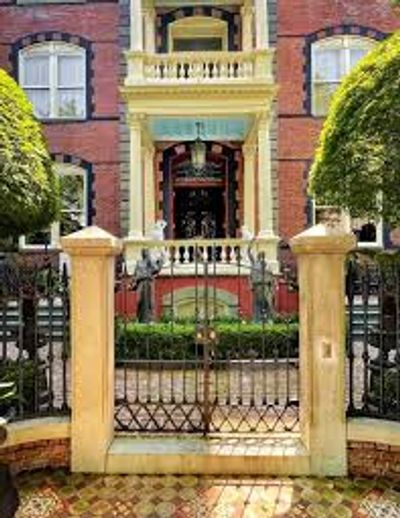
The Daniel Huger- William Bull House
The Daniel Huger House, situated at 35 Meeting Street, circa 1720, was built by William Bull, first Lieutenant Governor of the Royal Colony of South Carolina. This historic estate holds the distinction of being the oldest surviving residential structure on Meeting Street.
Throughout the colonial era, the mansion functioned as a central hub for early American politics, notably hosting General James Oglethorpe while he and William Bull mapped out the plans to establish the neighboring Province of Georgia. The home later passed to his son, William Bull II, a notable intellectual and fellow Lieutenant Governor who remained loyal to the British Crown as the tensions of the Revolutionary War escalated.
The neighborhood surrounding the home became the ultimate stage for revolutionary drama in the late summer of 1775. As revolutionary fervor gripped Charles Town, local citizens discovered resident Lord William Campbell's clandestine efforts to coordinate with backcountry Loyalists, forcing him to abdigate his authority. Realizing his life was in imminent danger from the local militia, Lord Campbell and his wife snuck out of the back of the Meeting Street residence under the cover of darkness, hurried through the yard, and escaped via a small boat moored in the nearby marsh of Vanderhorst Creek to seek permanent refuge on a British warship waiting in the harbor.
Lower Meeting Street
The James Simmons House
The James Simmons House
The James Simmons House
The James Simmons House, located at 37 Meeting Street, is a prominent late 18th-century residence that exemplifies the density and evolution of downtown Charleston’s historic architecture. Believed to have been constructed circa 1760 for James Simmons, a local lawyer, the home is situated on Lot 278 of the Grand Model of Charles Town, one
The James Simmons House, located at 37 Meeting Street, is a prominent late 18th-century residence that exemplifies the density and evolution of downtown Charleston’s historic architecture. Believed to have been constructed circa 1760 for James Simmons, a local lawyer, the home is situated on Lot 278 of the Grand Model of Charles Town, one of the earliest urban plans in the British colonies. Structurally, the residence was built as a traditional Charleston double house, featuring a formal Georgian floor plan with a central hallway dividing four principal rooms on each floor, all supported by solid brick exterior walls measuring nearly two feet thick.
Beyond its structural significance, the property has a history marked by wartime occupations and notable regional figures.Following Simmons's death in 1775, the home became the residence of Governor Robert Gibbes, whose family was forced to evacuate the property when British forces occupied Charleston during the Revolutionary War; they later returned to find the structure heavily damaged. In subsequent decades, the house passed to other high-profile owners, including Otis Mills, the prominent financier and owner of the nearby Mills House Hotel, who purchased the property in the 1840s. During the Civil War, the residence served a strictly utilitarian military purpose when it was loaned to Confederate General P.G.T. Beauregard, who utilized the strategic Meeting Street location as his official executive headquarters from October 1862 until August 1863.
The physical appearance of the house underwent permanent alterations that reflect the shifting architectural trends of the 19th century. Originally constructed with a flat facade, the front of the building was significantly modified during Otis Mills's ownership with the addition of twin two-story bay windows that curve symmetrically out over Meeting Street.These projecting bays are connected on the second story by an intricate, heavy cast-iron balcony, a design element that sets it apart from more conventional double houses in the neighborhood. In the modern real estate era, the expansive double-lot property, which covers roughly a third of an acre and includes an attached carriage house and wine cellar, has continued to set precedents, repeatedly breaking records as one of the most expensive residential sales in the historic district.
Three Sisters
The James Simmons House
The James Simmons House
The "Three Sisters" of Charleston, located at 101, 103, and 105 Meeting Street, represent one of the city's most visually distinct and frequently photographed architectural groupings. Situated just south of Broad Street, these three adjacent, narrow residences present a striking uniform density on the streetscape, defined by their pastel-
The "Three Sisters" of Charleston, located at 101, 103, and 105 Meeting Street, represent one of the city's most visually distinct and frequently photographed architectural groupings. Situated just south of Broad Street, these three adjacent, narrow residences present a striking uniform density on the streetscape, defined by their pastel-colored stucco facades, contrasting dark shutters, and closely aligned footprints. Despite local folklore suggesting they were built by a wealthy father for his three daughters, historical records reveal a much more practical and commercial origin.
The properties were actually developed in the mid-19th century by a single investor, a factor that accounts for their shared architectural rhythm. They are designed as classic Charleston "single houses," a regional layout where the narrow end of the structure faces the street directly to maximize property tax efficiency and capture prevailing coastal cross-breezes. While they share a common orientation and scale, close inspection reveals distinct individual variations in their rooflines and decorative detailing—ranging from gabled roofs to differing styles of ironwork on their small second-story balconies.
Today, the Three Sisters stand as a premier example of how Charleston’s historical preservation efforts have maintained the structural scale of the historic district. Their tightly clustered presentation highlights the high-density urban planning characteristic of the city's early development, where residential estates were continually subdivided to accommodate a growing merchant class. The houses remain private residences, serving as a landmark anchor along the lower Meeting Street corridor.
Water Street
The James Simmons House
Water Street
Water Street is a short, historic thoroughfare in downtown Charleston's South of Broad neighborhood that directly reflects the physical transformation and engineering history of the peninsula. Running east from Meeting Street down to East Battery, the street does not follow a standard colonial grid layout because it was not originally dry
Water Street is a short, historic thoroughfare in downtown Charleston's South of Broad neighborhood that directly reflects the physical transformation and engineering history of the peninsula. Running east from Meeting Street down to East Battery, the street does not follow a standard colonial grid layout because it was not originally dry land. Instead, it follows the precise path of Vanderhorst’s Creek, a deep, tidal saltwater stream that once cut into the peninsula and separated Church Street from the southern tip of White Point.
In the 18th century, the creek served as a natural boundary and was managed by a system of earthen fortifications and a 30-foot-wide tidal canal with a floodgate near the modern East Battery intersection.
The conversion from a waterway to a residential street occurred gradually between the late Revolutionary War era and the early 19th century. Following severe storm damage from the Great Hurricane of 1752 and subsequent urban fires, city commissioners and local property owners systematically confined and filled the creek bed with earth, ballast stone, and rubble to create new, high-density building lots for the expanding merchant class.
By the 1780s, the western section between Meeting and Church streets was officially recognized as Water Street, though the easternmost blocks remained a tidal canal dry only at low tide until the completion of the permanent East Battery seawall in the 1810s.
Because of its origins as a low-lying creek bed, the street contains distinct architectural adaptations designed to mitigate the Lowcountry's chronic water levels. Notable structures along the corridor, such as the Federal-style Francis Saltus House at 6 Water Street (built circa 1820) and the Italianate residence at 1 Water Street (built 1857), feature raised brick basements and elevated living quarters. In the modern era, the street has served as a testing ground for advanced preservation engineering; for instance, the historic brick structure at 1 Water Street became the first historic brick property in the district to be mechanically elevated eight feet off the ground to eliminate modern flood risk while maintaining its placement on the historic streetscape.
The Bells of Meeting: First Scots and St Michaels
First Scots Presbyterian

First Scots Presbyterian Church, located at 53 Meeting Street, is home to the fifth-oldest congregation in Charleston, founded in 1731 by a group of twelve Scottish families who withdrew from the Independent Church of Charles Town to preserve their traditional Presbyterian form of worship. The current sanctuary, completed in 1814, is the oldest surviving Presbyterian church building in the city. Designed by brothers John and Peter Williamson in the British Federal style, the exterior features massive twin towers, thick stuccoed brick walls, and a prominent display of the Burning Bush—the traditional symbol of the Church of Scotland—carved into the pediment above the main entry.
The construction of the 1814 sanctuary was an ambitious structural undertaking that required significant engineering adaptations to withstand the low elevation of the site. The building rests on a foundation of massive, hand-hewn cypress logs laid horizontally in trench beds beneath the brickwork to distribute the immense weight of the masonry across the marshy Lowcountry soil. This sub-structural design proved highly effective; while the building suffered fractured walls and lost its original symmetrical cupolas during the Great Earthquake of 1886, the underlying timber platform prevented the entire structure from settling unevenly or collapsing entirely into the earth.
The interior of the church reflects a strict adherence to early Scottish liturgical traditions, maintaining a stark contrast to the more ornate Anglican sanctuaries of the same era. It features a wide, unadorned gallery supported by fluted columns and a prominent central mahogany pulpit, which was specifically positioned to emphasize the delivery of the sermon over sacramental rituals. The churchyard surrounding the building serves as a dense historical record of Charleston’s early Scottish merchant class, containing highly detailed gravestones carved from imported New England slate and Scottish sandstone, many adorned with traditional thistles and family crests.
Like many historic houses of worship in Charleston, the story of the bells at First Scots Presbyterian is deeply tied to the logistical sacrifices of the Civil War. When the current sanctuary was completed in 1814, it was outfitted with a substantial bronze bell housed in its north tower, which served as a daily timekeeper and a call to worship for the local Scottish community.
That original bell hung in the steeple for nearly half a century until the spring of 1862. As the Union blockaded the harbor and tightened its siege around the city, General P.G.T. Beauregard issued a formal appeal to regional churches and citizens to surrender their bronze and brass to the Confederate ordnance department. Recognizing the severe shortage of raw manufacturing materials, the congregation voted to take down their historic bell and donate it to the war effort, where it was melted down at a foundry to be recast into artillery pieces for the defense of the city.
For the next 137 years, the twin belfries of First Scots remained completely silent. The empty north tower was finally reclaimed in 1999 when the church acquired and installed a historic replacement bell. Sourced from England, the modern-day bell was cast in 1814—the exact same year the Meeting Street sanctuary was originally built—restoring the authentic physical and acoustic footprint of the early 19th-century church.
St. Michaels
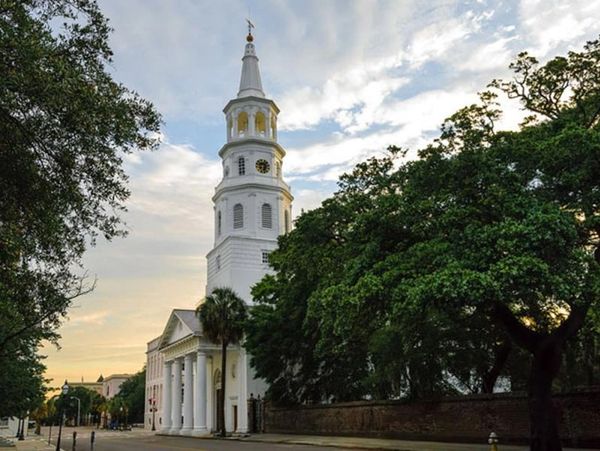
St. Michael's Church, located at the intersection of Broad and Meeting streets, is the oldest surviving church structure in Charleston, standing on the site of the city's first Anglican house of worship. Completed in 1761, the building is constructed of brick covered with stucco and features a prominent 186-foot steeple that has served as a navigational landmark for mariners entering the Charleston Harbor for over two centuries. The interior retains much of its original colonial configuration, including Native American cedar box pews and an ornate English-imported chandelier dating back to 1803.
The structure is historically notable for its survival through multiple major military conflicts and natural disasters. During the Revolutionary War, the white steeple was painted black to prevent British warships from using it as a sighting guide, and during the Civil War, the church bells were removed and sent to Columbia for safekeeping, where they were subsequently cracked during the burning of that city before being returned to England to be recast. The building also sustained significant damage during the Great Earthquake of 1886, which caused the massive tower to sink approximately eight inches into the soft Lowcountry soil.
The churchyard surrounding the structure functions as an important historical archive, containing the graves of numerous prominent early American figures. Among those interred on the grounds are two signers of the United States Constitution, John Rutledge and Charles Cotesworth Pinckney. The site remains an active parish and continues to be recognized as a defining anchor of Charleston's Four Corners of Law, representing ecclesiastical authority within the historic institutional core of the city.
The church’s eight bells, cast in 1764 by London’s Whitechapel Bell Foundry (the same foundry that cast the Liberty Bell), have crossed the Atlantic Ocean five separate times due to war and damage. When the British army evacuated Charleston in 1782 at the end of the Revolutionary War, the British commanding officer, Major James Craig, claimed the bells as a personal prize of war and shipped them to England. A wealthy London merchant, horrified by the theft, purchased them back out of his own pocket and shipped them back to Charleston.
During the Civil War, the congregation sent the bells inland to Columbia for safekeeping from Federal bombardment.However, they were caught in the catastrophic 1865 fire that consumed Columbia during General Sherman’s occupation.The intense heat caused the bells to crack and melt into fragments. After the war, the metal shards were carefully swept up, packed into crates, and shipped back across the Atlantic to the exact same Whitechapel foundry in London. The craftsmen melted down the original metal, poured it into the original 1764 molds, and shipped the recast bells back to Charleston for their fifth ocean crossing.
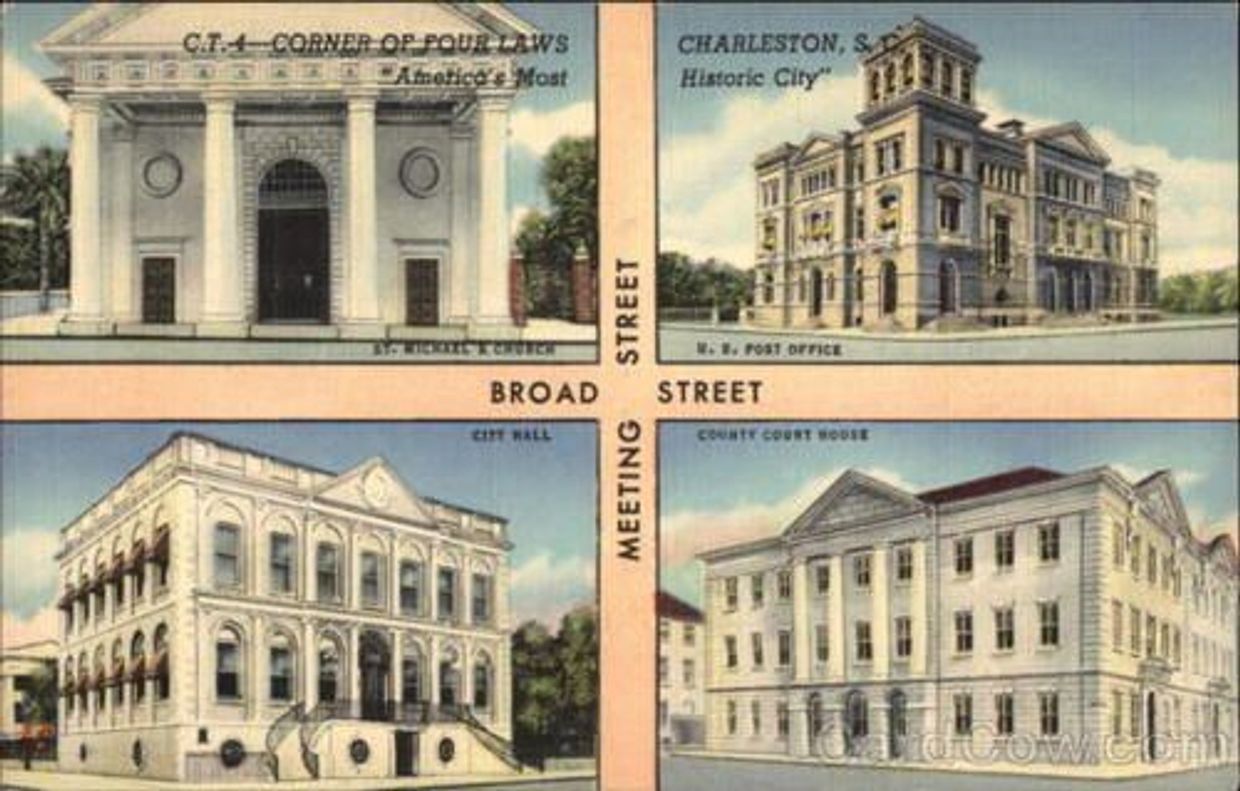
The Four Corners of Law
The "Four Corners of Law" is a distinct architectural and institutional intersection located in the heart of downtown Charleston at the crossroads of Broad and Meeting streets. The phrase, popularized by local writer and federal judge United States District Judge Ernest F. Hollings and later referenced by notable figures like Robert Ripley of Ripley’s Believe It or Not!, denotes that each of the four corners of this single intersection is occupied by a major building representing a distinct branch or level of law: ecclesiastical, federal, state, and municipal.
The southwest corner is anchored by St. Michael's Episcopal Church, completed in 1761, which represents ecclesiastical or canon law. Directly across the street on the southeast corner stands the United States Post Office and Courthouse, an imposing Renaissance Revival structure completed in 1896 that represents federal law. The northwest corner is occupied by the Charleston County Courthouse, a Neoclassical building designed by Irish architect James Hoban—who later designed the White House—representing state law, while the northeast corner features Charleston City Hall, constructed in 1801 as the First Bank of the United States and converted to municipal use in 1818, representing local municipal law.
This specific intersection has functioned as the political, legal, and social epicenter of Charleston since the city was laid out in the Grand Model plan of 1680. Rather than dispersing these vital institutions across the expanding peninsula, early planners concentrated them at this central juncture, creating a high-density civic hub where regional power was visibly consolidated. Today, the intersection remains fully operational in its historical capacities, with municipal offices, state courtrooms, federal chambers, and parish services all continuing to conduct official business from their respective corners.
We Would Love To Hear From You
Our tours are 100% private so we are able to work around your schedule. We do request 24 hours notice but you are encouraged to ask for "day of" availability and we will do our best to accommodate your request if possible.
These are walking tours and while we do not cover a long distance, you will need to be able to stand or walk for at least two hours. Please call us directly to book a tour or if you have any questions.
Please call 704.408.8787 to make a reservation.
Or reach us by email at casongaither@gmail.com